The conversation around artificial intelligence in the boardroom has shifted. We have moved beyond the novelty of generative text and into the era of agentic workflows. The question is no longer “Can AI write this email?” but “Can AI manage the entire campaign lifecycle?”
For C-suite leaders, this distinction is critical. We are witnessing the decoupling of marketing output from human headcount.

The New Operational Baseline
The integration of AI into marketing stacks has graduated from an experimental luxury to a competitive necessity. According to Harvard’s analysis of executive trends, AI adoption in marketing strategies has reached 69.1%, signaling that we have crossed the chasm from early adoption to mass application.
This surge isn’t driven by hype; it is driven by the collapse of production costs.
- Traditional Model: Content volume is limited by budget and human hours.
- Agentic Model: Content volume is limited only by strategy and compute power.
From Copilot to Autopilot
The most significant evolution is the rise of autonomous agents capable of executing complex, multi-step tasks without constant human intervention. These systems do not merely assist; they act. They conduct keyword research, draft content, optimize for SEO, and analyze performance data simultaneously.
Nielsen’s analysis of marketing redefinition highlights that this shift allows brands to achieve hyper-personalization at scale, moving beyond broad segmentation to individual customer targeting.
The Commodity Trap
However, this efficiency creates a strategic paradox. When every competitor has access to the same “zero-marginal-cost” content engines, volume ceases to be a competitive advantage.
The Insight: In an AI-saturated market, strategy becomes the scarce resource. The winners will not be the companies producing the most content, but those effectively orchestrating AI agents to deliver unique, brand-aligned value that cuts through the algorithmic noise.
The Agentic Shift: Your Transformation Story Begins
The transition from “AI-assisted” to “AI-driven” is not merely a software upgrade; it is a fundamental restructuring of the marketing org chart. We are witnessing the death of the “task-based” workflow and the birth of the Outcome-Based Architecture.
In the traditional model, a human marketer identifies a need, outlines a strategy, and executes the work—perhaps using AI to speed up drafting or research. The transformation story begins when we invert this relationship. Instead of humans using tools, humans now orchestrate agents.
From Copilots to Autonomous Agents
The distinction is critical. A copilot waits for a prompt; an agent pursues a goal.
Akira’s analysis of agentic AI highlights this evolution in the multi-channel landscape. We are moving toward systems that do not simply generate text but actively navigate marketing ecosystems—adjusting bids, scheduling posts, and reallocating budget based on real-time performance data without needing a human to click “approve” on every micro-decision.

This shift allows leadership to decouple output volume from headcount. However, it introduces a new operational requirement: the need for rigorous governance frameworks. If your AI agents are autonomous, your primary role shifts from “Editor-in-Chief” to “Chief Compliance Officer” of your brand voice.
The Infrastructure of Autonomy
Implementing this transformation requires more than a login to ChatGPT. It demands a robust data infrastructure that feeds these agents accurate, real-time context. An agent acting on six-month-old customer data is not an asset; it is a liability.
IBM’s insights on AI in marketing suggest that the most successful integrations occur when organizations treat AI not as a point solution for content, but as a systemic layer that connects customer data directly to execution channels. The transformation succeeds only when the AI has visibility into the entire customer journey, rather than being siloed in a “content creation” box.
The Strategic Imperative:
You must stop viewing AI as a productivity tool for your junior staff and start viewing it as a scalable infrastructure for decision-making. The goal is not to have your team write faster; it is to free your team to build the strategy that the AI executes.
From Generative Tools to Autonomous Agents
The prevailing narrative in boardrooms treats AI as a “super-intern”—a tool that waits for instructions to produce copy or generate images. This view is dangerously outdated. We are witnessing a fundamental architectural shift from Generative AI (creating assets) to Agentic AI (executing workflows).
The core concept here is autonomy. While a standard Large Language Model (LLM) responds to a prompt, an AI agent perceives an environment, makes decisions based on defined goals, and executes actions across multiple software platforms without constant human intervention.
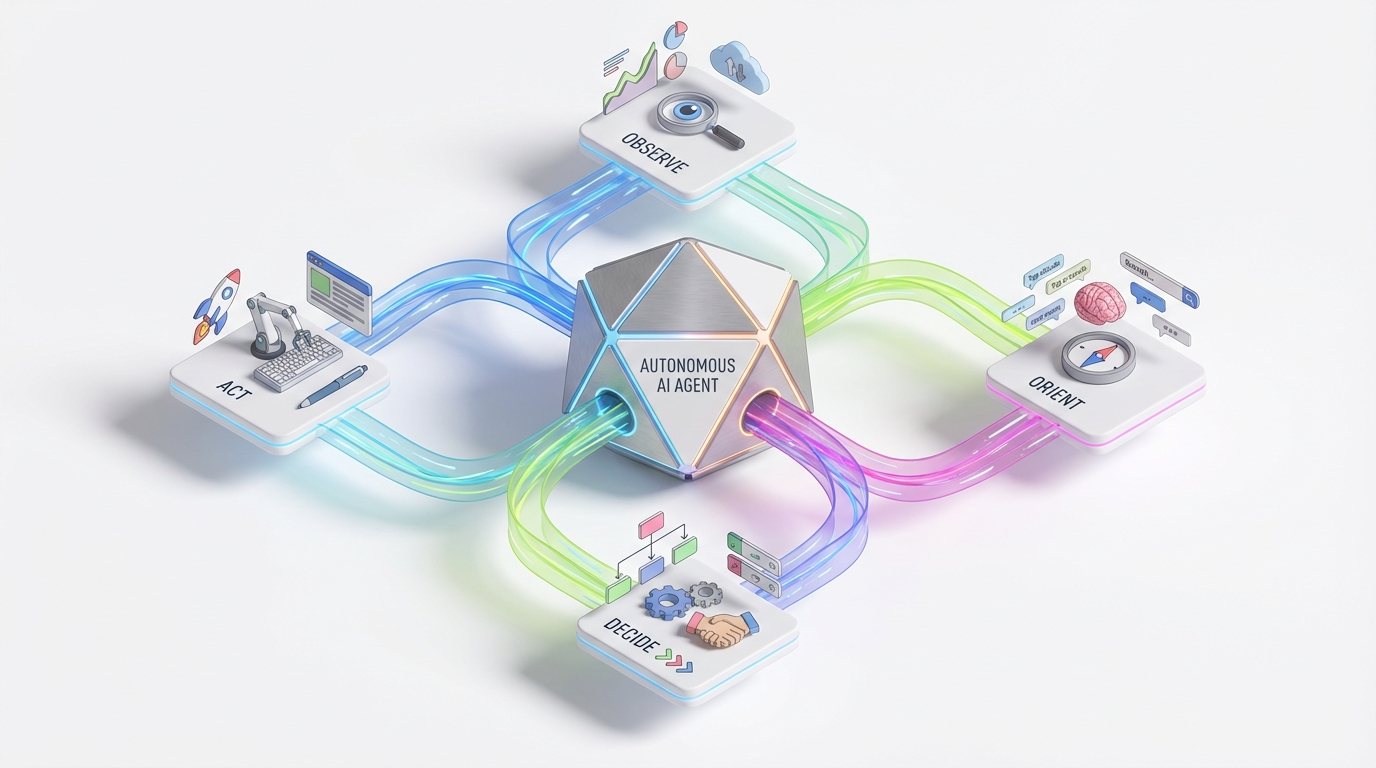
The Architecture of “Agentic” Marketing
At its heart, this transition involves moving from linear “prompt-response” interactions to dynamic “observe-orient-decide-act” loops.
In this model, the AI does not simply write an SEO article; it monitors search rankings, identifies decaying content, researches keywords, and updates the page automatically. Akira’s analysis of the agentic landscape highlights that these systems are designed to navigate complex multi-channel environments, effectively acting as autonomous operators rather than passive tools.
This distinction is critical for resource allocation. You are not buying software to assist your employees; you are deploying digital workers to manage the repetitive logic of your campaigns.
operationalizing the LLM
The engine behind this capability is the integration of LLMs with functional APIs. The LLM provides the reasoning capabilities (the “brain”), while integrations provide the execution capabilities (the “hands”).
Consider the SEO vertical. Gumloop’s approach to SEO automation demonstrates how LLMs are now leveraged for core functions like content audits and technical optimization. The system doesn’t just suggest a keyword; it scrapes the top 10 results, analyzes the semantic gaps, and restructures your existing content to outperform competitors—often before a human SEO manager has finished their morning coffee.
The Workflow Shift:
- Old Model: Marketer analyzes data > Marketer prompts AI > Marketer reviews output > Marketer publishes.
- Agentic Model: Agent monitors data > Agent detects opportunity > Agent drafts and stages update > Marketer approves.
The Multi-Channel Multiplier
The impact of this autonomy multiplies when applied across channels. A single human marketer struggles to maintain context between LinkedIn ads, email nurture sequences, and organic search intent simultaneously. AI agents face no such cognitive load limits.
According to Tofuhq’s review of B2B marketing tools, the current ecosystem allows for the deployment of specialized tools that handle distinct parts of the funnel, from lead scoring to personalized outreach, all operating simultaneously. The strategic advantage lies in synchronization—ensuring the agent managing your email sequencing is reacting in real-time to the behavioral data collected by the agent managing your web personalization.
The Automation Paradox
However, this operational leverage comes with a hidden cost: The Velocity of Error.
If your underlying strategy is flawed, Agentic AI will not fix it; it will simply execute that flawed strategy with ruthless efficiency and speed. We risk building “zombie loops”—automated workflows that burn budget and alienate customers faster than any human team could manage. The role of the marketing executive, therefore, shifts from managing production to managing the guardrails of these autonomous systems.
Unlock the Autonomous Engine: How It Works
To move beyond the “Velocity of Error,” executives must understand the mechanical shift from static automation to agentic autonomy. Traditional marketing automation follows a linear script: “If User clicks X, send Email Y.” This is fragile and requires constant human intervention to update the logic.
The new paradigm—Agentic AI—operates on goal-directed behavior. You do not tell the system what to do; you tell it the outcome you require (e.g., “Increase organic traffic by 15% in Q3”), and the system determines the optimal path.

The Cognitive Stack: From Data to Decision
The architecture of an autonomous marketing engine functions less like a tool and more like a digital employee. It operates through a continuous loop of observation and execution, often referred to as the OODA loop (Observe, Orient, Decide, Act).
1. The Observation Layer (Data Ingestion)
The AI continuously ingests market signals. This includes SERP volatility, competitor content velocity, and internal engagement metrics. Unlike human analysts who review reports weekly, the AI monitors this stream in real-time.
2. The Orientation Layer (Contextualization)
Raw data is meaningless without context. The system compares current performance against historical benchmarks and competitor movements. According to McKinsey’s insights on the next frontier of personalization, the value lies in using this data to trigger hyper-specific interactions that feel individually curated rather than broadly targeted.
3. The Decision Layer (Strategy)
This is where LLMs (Large Language Models) differentiate themselves. Instead of waiting for approval, the agent formulates a hypothesis. For example, it might decide that updating five existing high-intent articles will yield better ROI than writing ten new low-volume posts.
4. The Execution Layer (Action)
The agent interfaces with your CMS or ad platform via API to implement the change. As detailed in Gumloop’s breakdown of SEO automation, these systems now handle end-to-end workflows—performing content audits, executing keyword research, and optimizing on-page elements without a human clicking “publish.”
The Multi-Channel Orchestrator
The true power of this technology emerges when multiple agents coordinate across channels. A siloed SEO bot is useful; a coordinated fleet is transformative.
| Capability | Traditional Automation | Agentic AI Orchestration |
|---|---|---|
| Trigger | Explicit Rule (If/Then) | Strategic Goal (Increase ROAS) |
| Adaptability | Rigid; breaks if parameters change | Fluid; learns from failure |
| Scope | Single Channel | Cross-Channel Synchronization |
This synchronization allows for complex maneuvers. An AI agent noticing a dip in organic search traffic for a key term can instantly signal the paid media agent to increase bids for that specific keyword, protecting market share while the SEO agent diagnoses the root cause. Akira’s analysis of agentic AI highlights this capability to navigate complex multi-channel landscapes autonomously, effectively acting as a 24/7 campaign manager.
The “Black Box” Risk
While the efficiency gains are undeniable, the operational opacity creates a new strategic risk: The Context Gap.
AI agents are brilliant at optimization but often blind to brand sentiment. An agent might optimize a headline to maximize click-through rate (CTR) using clickbait tactics that degrade brand authority over the long term. It achieves the mathematical goal while failing the strategic mission.
Strategic Implication: The role of the human leader transitions from “Chief Creator” to “Chief Editor.” You must audit the decisions of the AI, not just the outputs. If you cannot see the logic chain your agent used to arrive at a decision, you are not running a campaign; you are gambling with your brand equity.
The Homogenization Trap: The Unexpected Fallout
The efficiency of AI comes with a hidden tax: the erasure of distinctiveness. When an entire industry utilizes the same underlying Large Language Models (LLMs) to generate strategy, copy, and SEO frameworks, the market suffers from Algorithmic Regression.
This is the “Sea of Sameness.” If your AI agent and your competitor’s AI agent are trained on the same internet data and optimized for the same Google ranking factors, they will inevitably converge on identical outputs. The result is a digital ecosystem flooded with technically perfect but creatively bankrupt content.
The Cost of infinite Scale
We are currently witnessing a paradox where the cost of content production approaches zero, but the cost of attention skyrockets. As noted in TastyIgniter’s analysis of AI content impacts, while the speed of generation is a massive advantage, the drawbacks include a significant potential for repetitive, generic phrasing that fails to engage human readers.
If you automate mediocrity, you simply scale noise.
| Feature | The AI Default | The Strategic Advantage |
|---|---|---|
| Tone | Neutral, safe, informative | Opinionated, distinct, provocative |
| Speed | Instantaneous output | Curated velocity |
| Source | Aggregated consensus | Proprietary data & experience |
| Risk | Hallucination & bias | Human error (manageable) |
The Ethical Minefield
Beyond boredom, there is the issue of liability. Autonomous agents do not understand cultural nuance or ethical boundaries unless explicitly constrained. They operate on probability, not morality.
This introduces significant brand safety risks. An AI agent might inadvertently optimize for keywords that are sensitive or biased, creating a PR crisis faster than a human team can detect it. As highlighted in Search Engine Land’s report on responsible implementation, ensuring ethical AI in SEO requires rigorous oversight to prevent bias and ensure transparency.
Strategic Implication: The value of your marketing team shifts from production to provenance. In a world of infinite AI generation, the premium asset is unique, verified human experience that an LLM cannot hallucinate. You must inject “Human Chaos”—unique opinions, proprietary data, and contrarian takes—into the AI machinery to break the cycle of homogenization.
The Strategic Pivot: From Operator to Orchestrator
The era of treating AI as a mere efficiency tool is closing. The next phase of competitive advantage belongs to leaders who transition their teams from operators of software to orchestrators of autonomous agents. This is not a subtle shift in tooling; it is a fundamental restructuring of your labor capital.
To survive the commoditization of content, you must redefine the role of your human talent. As Harvard DCE’s analysis of the future marketing landscape suggests, the successful integration of AI requires a strategic focus on high-value cognitive tasks while relegating execution to algorithms. Your roadmap for the next 12 months should prioritize three specific pillars:
- The “Data Moat” Audit: Generic LLMs produce generic results. Your competitive edge is now defined by the proprietary data you can feed these models. Immediate action: Audit your customer support logs, CRM data, and sales call transcripts. This is the raw material that turns a standard AI agent into a brand-specific expert.
- Agentic Workflow Design: Stop asking, “How can AI help us write this blog?” Start asking, “Can an AI agent own the entire SEO cluster maintenance loop?” Move from task assistance to process autonomy.
- The “Editor-in-Chief” Model: Realign your hiring strategy. You no longer need volume writers; you need subject matter experts who can verify, edit, and inject “Human Chaos” into AI-generated drafts.
The Executive Takeaway: The danger lies in the “Middle Ground.” Companies that fully automate without supervision will destroy their brand trust; companies that refuse to automate will go bankrupt from operational bloat. The winning strategy is a hybrid model: AI is the engine, but proprietary data is the fuel, and human strategy is the steering wheel.
Key Takeaways:
- AI is evolving from content creation assistants to autonomous agents managing entire marketing campaigns.
- 69.1% of companies are adopting AI in marketing, driven by collapsed production costs and scalability.
- Strategy, not volume, is the new competitive differentiator as AI makes content creation near-zero cost.
- Human roles shift from execution to orchestration, focusing on data strategy, governance, and brand voice.
Frequently Asked Questions
What is an “agentic workflow” in AI marketing?
Agentic workflows refer to AI systems that can autonomously pursue goals and execute complex, multi-step tasks without constant human intervention, moving beyond simple assistance to proactive campaign management.
How does AI change the competitive landscape for marketers?
With AI collapsing content production costs, volume is no longer a differentiator. The competitive advantage shifts to strategic orchestration of AI agents and leveraging proprietary data to create unique, brand-aligned value.
What is the “commodity trap” in AI-driven marketing?
The commodity trap describes a scenario where AI makes content creation so cheap and accessible that all competitors produce similar outputs, leading to a “sea of sameness” and a critical need for distinct strategy.
How does the role of human marketers evolve with autonomous AI agents?
Human marketers transition from task execution to orchestrating AI agents. Their focus shifts to data strategy, designing agentic workflows, and acting as “chief editors” to ensure brand voice and ethical compliance.