The Automated Psychology Engine
Marketing has evolved beyond simple segmentation. We have entered the era of industrialized persuasion, where algorithms do not merely predict behavior—they actively engineer it. For the modern C-suite, understanding this shift is no longer optional; it is the difference between possessing a competitive moat and facing obsolescence.
The current landscape is defined by a rapid integration of behavioral science into machine learning models. This is not about efficiency; it is about cognitive leverage. AI tools now systematically identify and exploit heuristics—mental shortcuts like scarcity, social proof, and loss aversion—at a scale human teams cannot replicate.
This strategic pivot is evident in current market dynamics. As organizations rush to adopt these tools, they face a complex intersection of opportunity and operational risk. According to Mktg.ai’s analysis of 2024 strategic trends, the adoption of AI is reshaping how brands approach market penetration, moving from broad strokes to hyper-personalized psychological targeting.
The implications for leadership are clear:
- Scale: You can now run thousands of multivariate psychological tests simultaneously.
- Precision: Targeting is based on emotional triggers, not just demographics.
- Risk: Algorithmic bias can inadvertently alienate core demographics if left unchecked.
The convergence of data analytics and human psychology creates a “black box” of influence that requires strict oversight. As highlighted in Robotic Marketer’s framework on data convergence, the ultimate marketing strategy now relies on decoding the decision-making process itself. Leaders must treat these tools not as simple utilities, but as powerful engines of behavioral modification that demand ethical governance and strategic intent.
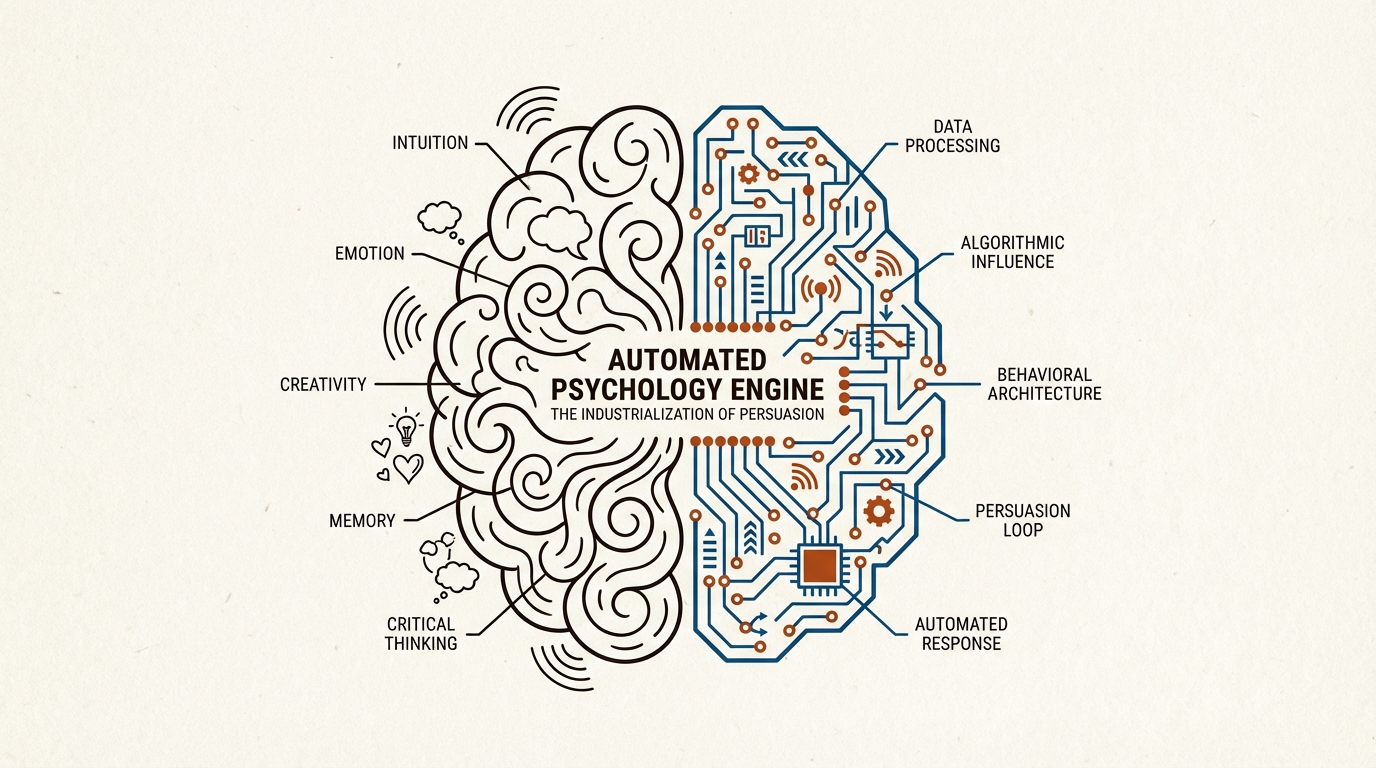
Automating Instinct: The Shift in Consumer Behavior
The deployment of AI in marketing has moved beyond simple demographic targeting; we are now witnessing the industrialization of instinct. Modern algorithms do not merely predict what a consumer wants. They actively construct the psychological environment necessary to trigger a purchase decision, effectively automating cognitive biases at scale. This shifts the CMO’s mandate from brand exposure to behavioral architecture.
The Scarcity Engine
The most visible application of this shift is the weaponization of scarcity. AI tools now integrate real-time inventory data with dynamic frontend displays to create a heightened sense of urgency. This isn’t just about low stock; it is about the perception of rivalry.
- Dynamic Anchoring: Algorithms adjust initial price points to make discounts appear more significant based on a user’s purchase history.
- Precision Timing: Countdown timers are deployed not randomly, but at the specific moment a user’s engagement metrics indicate hesitation.
- Inventory Velocity: “High demand” tags are generated by predicting sell-through rates, forcing immediate decisions.
This creates a high-pressure environment where the fear of missing out (FOMO) overrides logical price evaluation. As noted in a Government Report’s analysis of scarcity in marketing, these tactics fundamentally alter the “Promotion” and “Place” variables of the marketing mix, transforming static offers into time-bound psychological tests.
The Personalization Paradox
While these tools drive short-term conversion, they introduce a significant paradox: the efficiency of manipulation versus the sustainability of trust. When every interaction is optimized to trigger a psychological response, the consumer eventually builds immunity.
Forbes’s analysis on harnessing psychology suggests that while AI can significantly drive purchase decisions by aligning with cognitive biases, the line between “persuasion” and “coercion” blurs rapidly. Leaders must ask if they are building a brand or simply extracting value through algorithmic pressure. The most effective strategies today use these triggers sparingly, reserving high-intensity psychological levers for moments of genuine value rather than manufacturing artificial crises.
Unpacking the Bias Amplification Engine
AI does not create cognitive biases; it industrializes them. Traditional marketing relied on broad psychological principles—like placing impulse buys near the checkout—applied to the aggregate market. In contrast, modern AI tools function as precision-targeting engines that identify, isolate, and exploit specific cognitive vulnerabilities at the individual level.
The mechanism is not passive observation; it is active reinforcement. Algorithms ingest vast datasets of user interaction to determine exactly which psychological triggers—scarcity, authority, or social proof—yield the highest conversion rates for specific profiles. Entyx’s exploration of AI-driven marketing notes that these systems go beyond basic demographics to deconstruct the decision-making process itself, predicting the exact moment a consumer is most susceptible to influence.
The Mechanics of Algorithmic Anchoring
One of the most potent mechanisms is the automation of the “Anchoring Effect.” AI dynamic pricing models present an artificially high initial price point to establish a psychological baseline. When the system subsequently offers a “personalized discount,” the consumer perceives immense value, even if the final price remains higher than the market average.
This is no longer a manual strategy decided in a boardroom; it is a zero-marginal-cost operation running in real-time.
| Cognitive Bias | Traditional Application | AI-Amplified Application |
|---|---|---|
| Anchoring | Static MSRP printed on tags | Dynamic, user-specific “original prices” tested for max conversion |
| Scarcity | “Limited Time” seasonal sales | Real-time, personalized countdown timers triggered by page visits |
| Loss Aversion | “Don’t miss out” email blasts | Predictive notifications warning of inventory depletion based on browse history |
Psychographic Targeting at Scale
The engine’s power lies in its ability to marry behavioral data with psychographic profiling. It is not enough to know what a customer buys; the AI must understand why they buy it. According to Averi’s guide on AI and psychographics, sophisticated platforms now leverage sentiment analysis to align marketing messages with a user’s values, fears, and lifestyle aspirations.
This allows for the weaponization of Loss Aversion. By understanding what a specific user values most—whether it is social status, financial security, or exclusivity—the AI tailors the “threat” of missing out to hit the most painful psychological nerve. The system learns that User A responds to “saving money,” while User B responds to “losing access.”
The Feedback Loop of Bias
The danger for strategic leaders lies in the blind optimization of these tools. Because these algorithms are rewarded for engagement and conversion, they naturally gravitate toward the most extreme psychological triggers. Robotic Marketer’s overview of AI bias highlights a critical risk: when algorithms prioritize efficiency metrics above all else, they systematize human cognitive flaws, creating a feedback loop where users are constantly bombarded with their own biases reflected back at them.
This creates a closed cognitive ecosystem. The consumer sees what confirms their worldview or triggers their anxieties, and the marketer sees rising conversion rates, often ignoring the long-term erosion of brand integrity.
Unpacking the Algorithmic Engine: The Core Mechanics
We often describe AI in marketing as a “personalization engine,” but for the strategic operator, it is more accurate to view it as a psychological arbitrage machine. The algorithms do not simply match products to people; they systematically identify and exploit cognitive vulnerabilities to accelerate decision-making.
The shift here is from broad demographic targeting to micro-moment manipulation. While traditional campaigns relied on seasonal scarcity or broad discounts, AI tools now deploy specific heuristic triggers in real-time, tailored to the individual user’s browsing velocity and hesitation patterns.
The Triad of Automated Influence
To understand how these tools drive the 37% boost in purchase intent mentioned earlier, we must look at the specific gears turning the machine. The AI is not “being creative”; it is executing a high-speed optimization of three primary cognitive biases:
| Mechanic | The Traditional Method | The AI-Driven Evolution |
|---|---|---|
| Artificial Scarcity | “Sale ends Sunday” banners. | Real-time countdowns triggered by cursor hovering; dynamic inventory numbers (e.g., “Only 2 left at this price”). |
| Anchoring | MSRP printed on a tag. | Dynamic initial pricing based on user location and device, setting a custom “anchor” to make the discount appear larger. |
| Loss Aversion | “Don’t miss out” email subject lines. | Personalized notifications triggering fear of losing specific items left in carts or “reserved” status expiration. |
1. The Scarcity Loop
The most common lever AI pulls is urgency. By integrating with real-time inventory systems, marketing tools can generate a sense of immediate threat to the consumer’s opportunity. HubSpot’s analysis of the scarcity principle details how high demand is manufactured to shortcut logical decision-making.
In an AI context, this is no longer static. If a user lingers on a product page, the algorithm can trigger a specific scarcity message—”3 other people are viewing this”—designed specifically to break the analysis paralysis. The danger arises when this scarcity is fabricated, moving the strategy from persuasion to deception.
2. Anchoring and Price Perception
AI excels at setting the stage for value perception. The “Anchoring Effect” describes our tendency to rely heavily on the first piece of information offered (the “anchor”) when making decisions.
Algorithms now test thousands of initial price points to determine which anchor creates the highest conversion probability for a specific demographic. As noted in ArtWorkflowHQ’s breakdown of cognitive biases, brands leverage these initial reference points to manipulate the perceived magnitude of a discount. The AI learns that User A converts at a 10% discount off a high anchor, while User B needs a lower anchor but free shipping.
3. Weaponized Loss Aversion
The strongest psychological driver is not the desire to gain, but the fear of losing. AI tools are increasingly adept at framing inaction as a loss rather than a missed opportunity.
This goes beyond simple FOMO. By analyzing past behavior, the system predicts exactly what a user is afraid to lose—status, access, or a specific deal. Forbes Agency Council’s discussion on harnessing psychology suggests that AI’s ability to align marketing messages with these deep-seated fears is a primary driver of purchase decisions. The algorithm creates a scenario where the “pain” of not buying outweighs the cost of the product.

The Optimization Trap
The mechanism is effective, but it carries a hidden tax. When you rely on these triggers, you are training your customer base to respond only to manufactured urgency. You are not building brand loyalty; you are building an addiction to stimulus.
Strategic leaders must ask: Are we using AI to help the customer decide, or are we using it to bypass their judgment entirely? The former builds lifetime value; the latter burns it for quarterly results.
The Algorithmic Trust Deficit
The immediate lift in conversion rates provided by AI-driven scarcity and urgency often masks a more corrosive long-term metric: the erosion of consumer trust. When marketing automation moves from “persuasion” to “cognitive extraction,” you risk transforming your customer relationship from a partnership into an adversarial contest.
The danger lies in the scale of the deployment. A human copywriter might accidentally trigger a bias once; an AI system, incentivized by click-through rates (CTR), will trigger it millions of times per hour until the tactic creates a feedback loop of anxiety. Robotic Marketer’s breakdown of AI bias significance highlights a critical operational risk: without human oversight, AI models naturally drift toward whatever signals yield the highest immediate engagement, often amplifying existing societal or psychological biases rather than mitigating them.

The Echo Chamber Effect
The impact extends beyond the individual transaction. AI personalization engines, designed to show users “more of what they want,” effectively build psychological echo chambers. If a consumer responds to a fear-based prompt (e.g., loss aversion regarding a limited-time offer), the algorithm learns that “fear converts” for this profile.
Consequently, the user is bombarded with increasingly urgent, high-stress messaging. This is no longer marketing; it is automated emotional attrition.
Regulatory and Ethical Liability
This aggressive optimization does not exist in a vacuum. Regulatory bodies are increasingly scrutinizing “dark patterns”—UI/UX designs and algorithmic choices that coerce users into unintended actions. The Brookings Institution’s framework on bias mitigation warns that algorithmic systems optimizing solely for engagement often inadvertently violate consumer protection standards, necessitating robust “human-in-the-loop” auditing processes to prevent automated consumer harm.
The strategic implication for C-level leaders is clear: Efficiency is not a proxy for efficacy. An algorithm that doubles conversion by exploiting anxiety will eventually trigger a brand revolt or a regulatory inquiry. The winning strategy requires auditing your AI not just for performance, but for the emotional temperature of its output.
Your Future with AI Marketing: What’s Next?
We are approaching the saturation point of algorithmic extraction. As AI tools democratize the ability to trigger scarcity, loss aversion, and anchoring at scale, these tactics are rapidly depreciating from “psychological hacks” into “background noise.” The consumer market is developing an immunity to synthetic urgency, meaning the next competitive frontier is not better manipulation, but cognitive alignment.

The Shift to Trust Architecture
Forward-thinking organizations are already pivoting from exploiting biases to mitigating them. The winners of the next cycle will use AI to act as a fiduciary for the customer’s attention, not just a vampire of it. Behavioral Scientist’s analysis on algorithms fighting bias suggests that the same machine learning architectures currently entrenching consumer harms can be re-engineered to detect and neutralize them, turning ethical guardrails into a distinct market advantage.
Strategic Imperatives for the C-Suite
To survive the transition from “growth at all costs” to “sustainable resonance,” leaders must adjust their operational frameworks:
- Audit for Emotional Toxicity: Measure your campaigns not just by Conversion Rate (CVR), but by Churn Correlation—are your high-pressure tactics burning out your audience?
- Invert the Algorithm: Value metrics that reward Customer Lifetime Trust (CLT) over immediate click-throughs driven by panic.
- Transparency as a Feature: Explicitly label AI-generated scarcity (e.g., “This inventory count is real-time”) to differentiate from competitors using “black box” pressure tactics.
The future belongs to brands that use AI to reduce cognitive load, not amplify it.
Key Takeaways:
- AI marketing tools systematically exploit cognitive biases like scarcity and loss aversion at an unprecedented scale, driving short-term gains.
- These tools create a feedback loop, amplifying biases and potentially eroding consumer trust and brand integrity long-term.
- Future competitive advantage lies in using AI for cognitive alignment and trust, not just exploiting psychological triggers.
Frequently Asked Questions
How do AI marketing tools replicate human cognitive biases?
AI tools analyze vast user data to identify individual psychological triggers and heuristics, such as scarcity or social proof. They then systematically deploy these triggers at scale, often through dynamic pricing or personalized urgency messaging, to influence decision-making.
What are the main cognitive biases AI marketing tools exploit?
The primary biases exploited are scarcity, creating a sense of urgency; anchoring, by manipulating initial price points to make discounts seem more significant; and loss aversion, by emphasizing what a user might miss out on.
What are the risks of AI amplifying cognitive biases in marketing?
The risks include eroding consumer trust through perceived manipulation, creating a feedback loop where users are constantly exposed to their own biases, and potential regulatory scrutiny for using “dark patterns” that coerce unintended actions.
How can businesses use AI marketing ethically while avoiding bias amplification?
Businesses should focus on using AI for cognitive alignment and building trust, rather than solely for exploitation. This involves auditing for “emotional toxicity,” valuing customer lifetime trust over immediate clicks, and implementing transparency about AI-driven tactics.
What is the “personalization paradox” in AI marketing?
The paradox lies in the conflict between the short-term efficiency gained from hyper-personalized psychological targeting and the long-term sustainability of consumer trust. Over-optimization can lead to consumer immunity and brand erosion.